


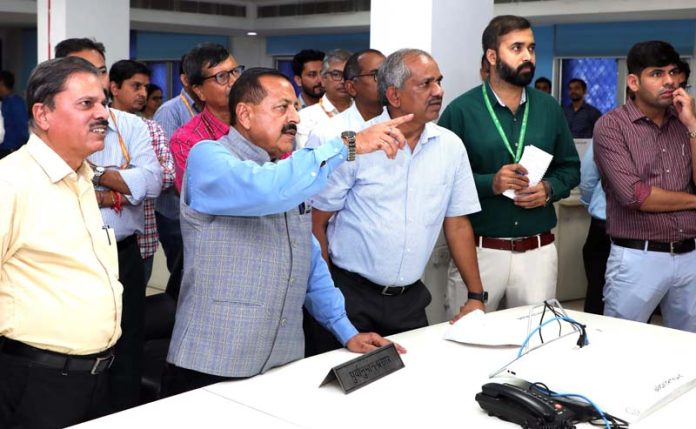
Union Minister of State (Independent Charge) for Science and Technology, Earth Sciences, and Minister of State in the Prime Minister’s Office, Dr. Jitendra Singh, reviewed the India Meteorological Department (IMD)’s cutting-edge Web-GIS based Multi-Hazard Early Warning Decision Support System (DSS) today, which has generated an impressive cost saving of ₹250 crore.
The minister recognized the IMD’s achievement in developing a self-reliant, technology-driven, and citizen-centric forecasting platform. This innovation strengthens disaster preparedness and promotes public safety throughout the nation. He highlighted the DSS’s cost efficiency, which eliminates reliance on foreign vendors and saves an additional ₹5.5 crore in annual maintenance costs, aligning perfectly with the Atmanirbhar Bharat vision.
Dr. Singh also examined “Mausamgram” (Har Har Mausam, Har Ghar Mausam)—a grassroots weather information platform providing hyperlocal forecasts at the village level. This comprehensive system offers hourly forecasts for 36 hours, three-hourly forecasts for five days, and six-hourly forecasts for up to ten days. Users can easily access forecasts using PIN code, location name, or by selecting their state, district, block, and gram panchayat. Available in all official Indian languages, “Mausamgram” ensures accessibility for every citizen across the country.
The IMD has modernized its forecast and alert generation process, extending the lead time from five to seven days. This update reduces forecast preparation time by three hours and improves accuracy by 15–20%. During discussions with IMD officials, Dr. Singh stressed the need to incorporate AI-based tools into “Mausamgram,” making it more interactive and user-friendly. He urged the department to bolster the Multi-Hazard Early Warning System by providing clear and actionable alerts that facilitate timely disaster responses.
The minister congratulated the IMD team for winning the National Award for e-Governance 2025 during the 28th National Conference on e-Governance held in Visakhapatnam. This accolade recognizes the IMD’s excellence in digital public service delivery through the DSS system.
Moreover, Dr. Singh praised the Department for their efforts under the Special Swachhata Program, which has successfully generated ₹30 lakh from disposing of e-waste and old files, while also clearing 600 square meters of space. Participating in the “Special Swachhata Program 5.0” at the IMD headquarters, “Mausam Bhavan,” he planted a sapling under the “Ek Ped Maa Ke Naam” campaign and honored 50 “Safai Mitras” for their dedicated service.
Looking toward the future, Dr. Singh outlined the objectives of Mission Mausam. By installing advanced meteorological instruments by 2030, the IMD aims to enhance its forecasting capabilities significantly. This initiative will enable 5×5 km-scale hazard forecasting, ensure dynamic impact-based forecasting, and provide risk-based early warnings. Ultimately, the goal focuses on achieving last-mile connectivity to guarantee that early warnings reach every household, fulfilling the vision of “Har Har Mausam, Har Ghar Mausam.”

